Delicious Christmas and New Years recipes... from Italy
Over the holidays, we at NOI talked a lot about what "festive" contents we could bring on the blog. So here's the first of a series of posts that will tell you a bit about the unique, extravagant and spectacular ways in which Christmas and New Year are celebrated in our corners of the world! And what could be a tastier beginning than holiday food? - CRI, NABS, GEORGE
So here's for you, an insight into Christmas and New Years recipes in Italy! Because we have much more than spaghetti and pizza up our sleeves, and Christmas is the time of the year when truly my country shines at its finest! - CRI
It's no secret that Italy has long been renowned for the quality of its food. From Northern to Southern Italy, the traditional holiday recipes range over a wide variety of delicious treats; appetizers, first and second courses (either fish or meat based) and of course the most authentic symbol of Christmas - the desserts, with the timeless "rift" between Pandoro and Panettone. So for your enjoyment, here's a thorough look at some of the most typical delicacies that Italy offers around this time of the year.
 |
| Dammit, I wish the holidays weren't over. -GC |
Salmon, the king of Christmas recipes
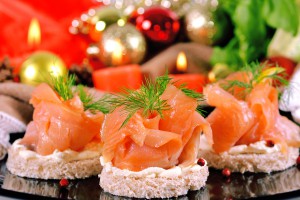
While salmon is a popular treat in many other countries during the holiday seasons, in Italy you could almost say it's something of a national dish all through December. We're talking, in the specific, of smoked salmon which may be either Scottish or Norwegian; usually the Norwegian salmon is thought to be more delicate, while the Scottish salmon has a "stronger" flavour. Salmon-based appetizers, in which delicious slices of fish are served with butter (and sometimes mayo, caviar, or roe) over various kinds of bread, from bruschetta to sandwich to vol-au-vants, are extremely popular.
Another big-time favourite is salmon crepes or pasta (preferably long pasta, like spaghetti) topped with butter or cheese sauce and sprinkled with tiny, soft slices of salmon all over. The key for a successful smoked salmon pasta is that the salmon should be the predominant flavour, with its strong and salty taste sweetened by the buttery undertones - which means that a lot of minced salmon goes into this dish, in order to get the perfect balance of flavours. With its creamy texture enhanced by the salmon morsels, this recipe is very different in taste from the usual "salmon and sour cream" pasta dressing you can sample during the rest of the year, and which is usually done with fresh (steamed) salmon and herbs.
 |
| I LOVE SALMON! -Nabs |
Fish soup and marinated eel (Capitone) for the holidays
Another popular tradition is fish soup, which is especially favoured in Southern Italy. Typically, the fish is acquired at least on 23th (if not on the very morning of Christmas Eve) and include hake, salmon, red mullet, gurnard, mantis shrimps, shrimps, rockfish, ray-finned fish, and much more. This soup may be served on its own with toasted bread, but more commonly as pasta topping; again, the pasta should preferably be long, and one particular Southern Italy treat you'll seldom get to taste anywhere else are the "maccheroni di Natale" (not to be mixed with maccheroni); a kind of mix between penne and spaghetti, but soft like lasagna. Maccheroni di Natale is very very tricky to eat as not only they tend to slide off the fork, but the sauce itself will slide off them if you don't wolf them down quickly enough; still, the challenge itself is half the fun, and they are absolutely delicious.
 |
| What a fine m-eel! Hahahaha -Nabs |
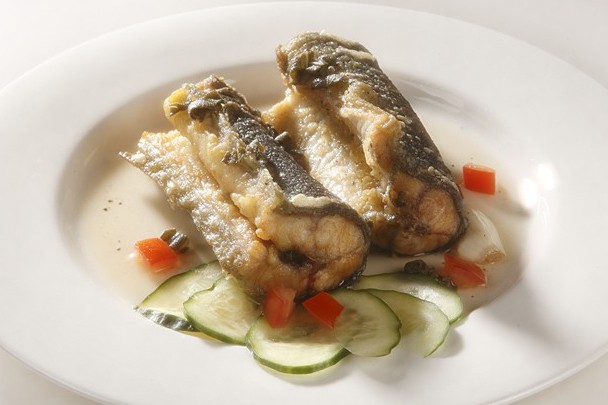
A typical Southern Italy treat is the marinated female eel known as Capitone. Especially in Naples, you can't literally imagine a Christmas or New Year dinner without the Capitone! This dish is so popular that it even found its way in the smorfia Napoletana, a local kind of Kabbalah in which various words have their numeric counterpart (in this case, 32. Yes I know what you're thinking - it's only a digit away from the answer to life, the universe and everything). In the past centuries fishmongers used to sell living female eels (who sometimes fell over their buckets and caused ruckus among people, while thrashing in desperate attempts to return in the water) and either decapitated them neatly on the spot when they were purchased, or sometimes even sold them alive and it was the purchaser who would proceed to kill the poor thing at home (and yes, that's as brutal and cruel as it sounds, but sadly traditions are sometimes gross like that). Fortunately, nowadays it's not near so common and the capitone is sold already marinated and filleted, sometimes even deep-fried. The legend goes that this dish became so popular in the Parthenopean cuisine for its strong allegoric imagery; eel looked snake-like, so it was believed that to cook and eat them at Christmas time would both represent the defeat of the Devil (represented as a snake in the Christian Bible) at the hand of God, and be a good omen for the New Year. A more practical reason was that eels are highly nutrient with lots of fats, and used to be cheap enough to be affordable even for the poorest families who couldn't buy more expensive fish food.
Cappone or "capon", the Christmas chicken
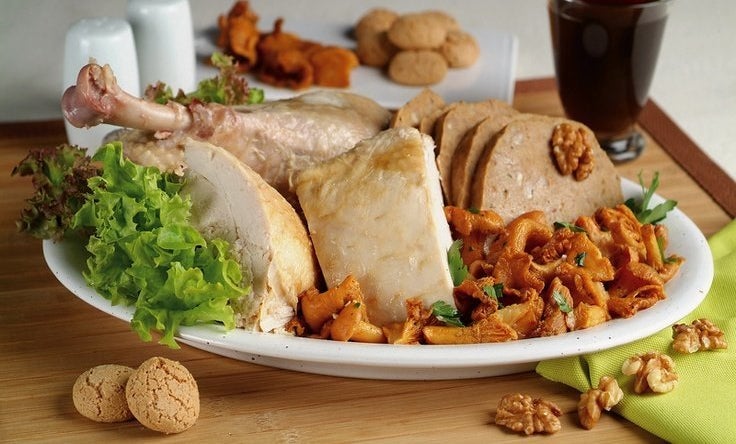
I know that most of our oversea readers are going to think that turkey, not chicken, is the go-to white meat during the holidays. However, in my country turkeys are becoming increasingly popular only in more recent years, as they used to be associated with "foreign" holidays like Thanksgiving, but not really part of our traditions. In Italy we instead cook the cappone or "capon", a young cockerel that gets neutered when about one month old and later fattened until it reaches the desired weight and tenderness of the meat.
 |
| I can almost smell it. -GC |
(Funnily enough, "cappone" in Italy is also the name of a kind of fish, the gurnard, which may be served around Christmas time in fish soup; better double check what you're going to eat before you order!)
The "chicken" capon can be served in a great variety of ways during the holiday. With its size halfway between an ordinary chicken and turkey hen, it's very often stuffed and roasted; the stuffing is almost always ham or other kinds of red meat, providing a contrast in flavors. However, many people also prefer to eat it boiled, with steamed vegetables as side dish. This particular recipe was often considered the most versatile as one capon would cover for the entire meal; the aforementioned "maccheroni di natale" were cooked in its broth, the boiled meat was served as main course, and the cold leftovers were mixed with chopped vegetables, seafood and toast and later set in jelly (somewhat like an aspic), to be served with a generous dollop of green sauce (NOT to be mistaken with pesto!) in what is known as "cappon magro".
Alternatively, the minced capon meat can be used either as stuffing for appetizers and horse d'oeuvres, or for yet another traditional dish - stuffed pasta!
Ravioli, pansoti, tortellini; stuffed pasta all the way (across the sky holidays!)
Ah, stuffed pasta. By what I can say, it's very hard to come across a holiday menu without at least an offering of ravioli or other stuffed goods. Very often, they are swapped with salmon or fish soup pasta, with one dish being served on Christmas and the other on New Year. The stuffing itself is as varied as it can be! In general. stuffed pasta will be made with the leftovers of the "main" course; chicken, fish or meat (but there's also a vegetarian take, in which spinach and chards are mixed with a typical Ligurian cheese, the "prescinseua" - pronounced PRE-sheen-SAW-a), but just about any combination is possible.
 |
| Ravioli, ravioli, give me the foodioli - Nabs |
What are the keys differences between each kind of stuffed pasta? First and foremost, the shape and appearance, but also the stuffing and the more typical way to serve them. Ravioli are square, and usually stuffed with meat (or sometimes fish). They are also in general larger and resemble a postal stamp in their overall appearance. Tortellini (and their larger version, tortelloni) are rounds, stuffed only with meat and unlike ravioli (which can be served with any kind of sauce) these are most traditionally cooked in broth or with soups - if they are well made, the pasta won't come off and there shouldn't be any meat dumpling floating around. Finally, pansoti can be stuffed either with meat or vegetables, they are more triangular in shape and, similarly to the ravioli, can be served with about any sauce - though their "default" topping is the nuts sauce or "white pesto".
And the sweet conclusion - in all meanings...
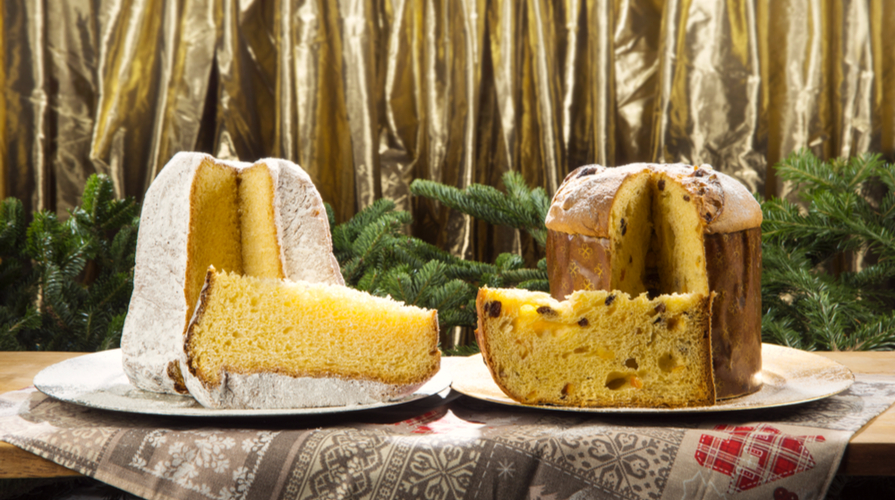
Last but not least - or as ancient Latins would say, "dulcis in fundo" - quite fittingly! - a guilty pleasure all of its own; the desserts! They have become so typical they are in themselves a symbol of the holiday season. There's actually a timeless debate going on even nowadays between those who like the Pandoro and the lovers of Panettone; these cakes, both rather tall and spongy in texture, were created respectively in Milan (Panettone) and Verona (Pandoro), with a Ligurian variant - the Pandolce - which is flatter and more crisp.
 |
| Mmmmm... -GC |
The Pandoro is usually sprinkled in powdered sugar and can be stuffed with chocolate, pistachio or Chantilly cream (sometimes even ice cream!); it's shaped like a spiky triangle, and cut horizontally so that each slice looks like a half-star. The Panettone is somewhat shorter and dome-shaped, it never includes powdered sugar and is stuffed with candied fruit of various kind, mostly raisins and sometimes almonds. Also, its crust is somewhat thicker than that of the Pandoro, and the texture is dryer, less soft and compact. Despite their very localized origins (which are the pride of both Milan and Verona), Panettone and Pandoro soon became widespread all over Italy and even to date remain the most popular Christmas dessert.
 |
| Here in the UK, our nicest dessert is bread-and-butter pudding. Puts things into perspective, doesn't it? -GC |
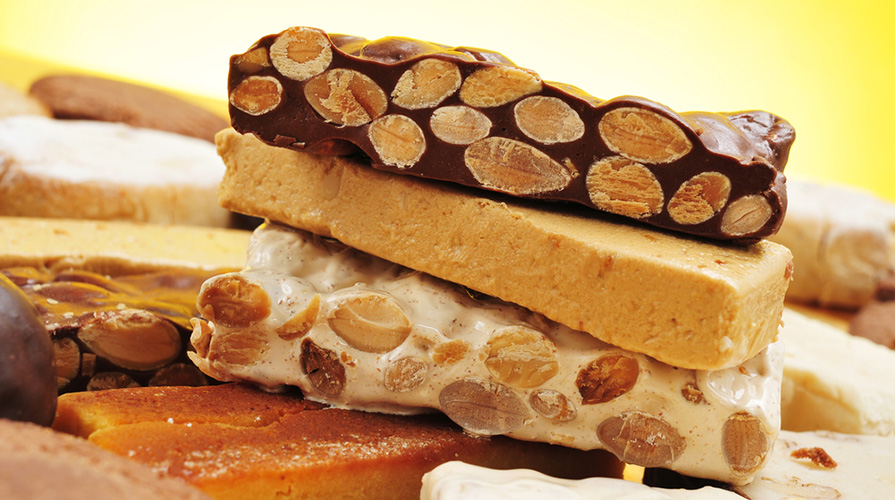
Dried fruit is considered a good omen in Italy, as are pomegrains which are almost never missing from the tables. And - of course - there's the torrone sweet, available in two versions; soft (which is our answer to the nougat) and hard. But because many people over the years were not so fond of eggs, or could not consume it, a third variant also came up; the nocciolato. This decidedly fabulous *cough*not biased*cough* candy is sold in blocks or bars of the same size of nougat but made entirely of chocolate (which can be itself dark, white or milk-flavoured) in which hazelnuts have been dipped. (And yes, before you ask, I always take the nocciolato instead of the torrone sweet, big chocoholic that I am XD)
And these are just some of the more typical holiday recipes and delicacies I could list off the tip of my fingers! If the post made you hungry and you're considering touring to Italy in the holiday season... well, I surely can't blame you! Food is by far one of the best thing to savor around this time of the year. But Italy offers much more besides, and in my next post I'll tell you a bit about the holiday tradition and folklore of my country.


No comments:
Post a Comment